
Protect Healing, Restore Function, and Support Recovery
When injury, surgery, or chronic conditions affect the hand, wrist, or elbow, it can disrupt nearly every aspect of daily life—from work tasks to self-care to recreation. As an Occupational Therapist and Certified Hand Therapist (OT/CHT), one of the most powerful tools I use to guide recovery is the custom-fabricated or custom-fitted orthosis.
Custom orthoses are not “one-size-fits-all” devices. They are carefully molded to the contours of each individual’s anatomy, condition, and functional needs. This creates unparalleled comfort, protection, and biomechanical precision during healing.
This guide explains the major types of orthoses, common conditions addressed, and the science and craftsmanship behind orthotic design.
Custom Immobilization Orthoses
Immobilization orthoses protect healing tissues by restricting targeted movements. These are essential following fractures, tendon or ligament repairs, and during painful inflammatory or degenerative conditions.
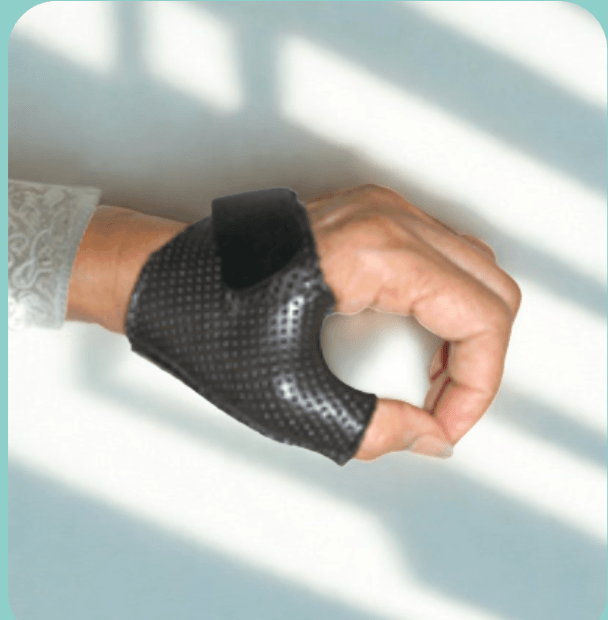
Short Opponens (Hand-Based Thumb Spica)
Stabilizes the thumb CMC and MCP joints while leaving the wrist free.
Common uses: thumb CMC arthritis, thumb MCP ligament injuries, mild De Quervain’s, and post-immobilization support for thumb fractures.
Long Opponens (Wrist-Based Thumb Spica)
Immobilizes the wrist and thumb.
Common uses: De Quervain’s tenosynovitis, scaphoid and other carpal fractures, thumb fractures, ligament repairs, and post-operative thumb reconstruction.
Wrist-Hand Orthosis (Cock-Up Splint)
Positions the wrist in functional extension, using volar, dorsal, or circumferential designs.
Common uses: distal radius fractures (post-cast), carpal tunnel syndrome, wrist sprains, wrist tendinitis, instability, arthritis, and post-operative wrist protection.
Dorsal Blocking Orthosis
Holds the wrist and fingers in flexion to protect flexor tendon repairs.
Common uses: flexor tendon repair protocols, volar plate injuries (modified designs), and surgeries requiring controlled extension limits.
Radial, Ulnar, and Digital Gutter Orthoses
Immobilize specific fingers or hand columns.
Common uses: phalanx and metacarpal fractures, central slip injuries, collateral ligament sprains, tendon repairs, and protection of digit-specific injuries.
Figure-of-8 Orthosis
Provides targeted stabilization at the PIP joint.
Common uses: swan neck deformity, boutonnière deformity, hypermobility, and ligament injuries. Turn it upside down for blocking a trigger finger.
Posterior Elbow Mold
Immobilizes the elbow in controlled degrees of flexion and forearm rotation.
Common uses: elbow fractures, dislocations, ligament repairs, ulnar nerve protection, and post-operative stabilization.
Munster Orthosis
Restricts forearm pronation and supination while allowing limited elbow movement.
Common uses: distal radius fractures, DRUJ instability, TFCC injuries, and forearm fractures.
Sarmiento Brace
Circumferential humeral fracture brace allowing functional motion while maintaining alignment.
Common uses: non-operative humeral shaft fractures.
Custom Mobilization Orthoses
Mobilization orthoses apply controlled forces to restore motion or assist weak musculature. They may be static-progressive, dynamic, or serial-static depending on the therapeutic goal.
Digit Flexion Mobilization
Applies low-load prolonged stretching to improve finger flexion.
Common uses: post-fracture stiffness, tendon adhesions, capsular restriction, and scar limitation affecting fist formation.
Radial Nerve Palsy Wrist and Digit Extension Orthosis
Can provide static positioning or dynamic assistance to allow functional grasp and release.
Common uses: radial nerve palsy, posterior interosseous nerve (PIN) syndrome, post-operative decompression, and severe extensor weakness.
Elbow Flexion Mobilization Orthosis
Provides static-progressive or dynamic stretch to regain elbow flexion.
Common uses: post-fracture stiffness, capsular tightness, post-operative scarring, and heterotopic ossification protocols.
Pronation/Supination Mobilization Orthosis
Applies rotational torque to gradually restore forearm rotation.
Common uses: post-fracture stiffness (radius/ulna), DRUJ capsule tightness, immobilization stiffness, and post-operative forearm repairs.
Common Conditions Addressed With Custom Orthoses
Custom orthoses are used across a wide range of diagnoses, including:
- Fractures of the hand, wrist, forearm, elbow, and humerus
- Tendon repairs, including flexor and extensor tendon reconstructions
- Ligament injuries and repairs, including UCL thumb repairs, PIP/MCP collateral sprains, volar plate injuries, TFCC injuries, and elbow ligament repairs
- Tendinitis and overuse conditions, such as De Quervain’s, lateral/medial epicondylitis, extensor and flexor tendinopathies, trigger finger/thumb and intersection syndrome
- Arthritis, including CMC arthritis, wrist arthritis, and RA-related deformities
- Nerve conditions, such as carpal tunnel syndrome, cubital tunnel syndrome, radial nerve palsy, and Guyon’s canal compression
The Materials: Low-Temperature Thermoplastics and Their Advantages
Most upper-extremity custom orthoses are made from low-temperature thermoplastics (LTTs). These materials soften in warm water (around 140–160°F) and become moldable within seconds, allowing the orthosis to be shaped directly to the patient’s limb.
Why low-temperature thermoplastics are ideal:
- Precise molding: conforms perfectly to individual anatomy
- Adjustability: can be reheated and re-molded as swelling resolves or protocols change
- Lightweight and durable: strong enough to maintain alignment yet comfortable for long-term use
- Variable rigidity: different materials provide options from flexible to highly rigid depending on diagnosis
- Ventilation options: perforated materials improve breathability without compromising strength
These materials allow an OT/CHT to create orthoses that match a patient’s healing phase and functional goals.
The Physics Behind Orthotic Design
Effective orthoses rely on mechanical principles:
Three-Point Pressure Systems
Immobilization orthoses commonly use a three-point pressure system to limit motion or align a joint. Strategic placement of straps and thermoplastic contours distributes force safely and effectively.
Lever Arm Optimization
Longer orthoses reduce pressure on the injured area by increasing the lever arm, improving comfort and protection (e.g., long opponens vs. short opponens).
Low-Load Prolonged Stretch
Mobilization orthoses use sustained, gentle force to stimulate tissue remodeling without overloading healing structures—key for managing stiffness.
Force Direction and Line of Pull
Dynamic mobilization splints must maintain an exact line of pull to encourage correct tendon gliding and prevent joint deformity.
This combination of biomechanics and material science ensures that each orthosis supports healing while promoting optimal function.
The Blend of Art and Science
Orthotic fabrication is both a technical discipline and a craft.
- The science lies in understanding anatomy, tissue healing timelines, physics, biomechanics, and material properties.
- The art emerges in how the therapist shapes, contours, and finishes the orthosis so it is comfortable, elegant, durable, and functional for the patient’s unique daily life.
A well-made orthosis feels natural, supports healing without creating secondary problems, and integrates seamlessly into routines such as typing, lifting, childcare, cooking, or sleeping.
Every piece is custom. No two are the same.
Why Custom Matters
A custom-fabricated orthosis provides:
- Superior comfort
- Precise protection that adapts to surgical protocols
- Improved healing and reduced stress on injured structures
- Optimized functional positioning for daily activities
- Adjustability as symptoms change
- Durability over prolonged recovery periods
Most importantly, your OT/CHT ensures that the orthosis fits your lifestyle, whether you’re caring for kids, working at a computer, lifting at the gym, or recovering from complex surgery.
Need hand therapy in Evanston, IL? Seeking post-op care? Click the link for my website and make an inquiry about occupational therapy services. Providing compassionate care for clients in the Chicago area and North Shore.
 Flourish Recovery & Wellness